Enhancing Durability, Precision, and Operational Life in Critical Industrial Components
In modern manufacturing and industrial operations, component longevity is directly linked to productivity, maintenance costs, and overall system reliability. Among the components that face the highest degree of friction, abrasion, and impact are wear plates — essential elements designed to protect machinery surfaces from continuous wear.
Laser hardening of wear plates has emerged as one of the most advanced and precise surface treatment technologies in today’s manufacturing ecosystem. By improving surface hardness without compromising the core toughness of the material, laser hardening significantly extends service life, reduces downtime, and enhances performance consistency across demanding applications.
This process has become increasingly important in industries such as automotive, heavy engineering, OEM manufacturing, industrial maintenance, and precision manufacturing, where component failure can lead to costly operational interruptions.
What Are Wear Plates?
Wear plates are specially engineered metal plates used to protect equipment surfaces that are exposed to friction, erosion, abrasion, impact, or sliding contact.
They are commonly installed in machinery and systems where continuous material movement or repetitive contact causes surface degradation over time.
Typical applications include:
Conveyor systems
Chutes and hoppers
Mining and construction equipment
Press tools and dies
Guide rails and support surfaces
Turbine and shaft protection assemblies
The primary function of a wear plate is to absorb wear instead of allowing the base equipment to degrade. However, even wear plates themselves experience progressive surface damage under extreme operating conditions.
This is where laser hardening becomes critical.
Why Is Laser Hardening Needed for Wear Plates?
Traditional wear plates, although made from robust alloys, often operate in highly aggressive environments involving:
Metal-to-metal contact
Continuous abrasive particle flow
Cyclic loading
High contact pressure
Repetitive impact stress
Over time, these conditions can cause:
Surface wear
Micro-cracking
Reduced dimensional accuracy
Loss of mechanical efficiency
Frequent replacement cycles
Conventional hardening methods such as flame hardening or induction hardening can improve hardness, but they often introduce larger heat-affected zones, distortion risks, and reduced dimensional control.
Laser hardening addresses these challenges with unmatched precision.
By using a controlled, high-energy laser beam, only the required surface layer of the wear plate is rapidly heated above its transformation temperature, followed by self-quenching through the surrounding material mass.
This creates a hardened martensitic surface layer while preserving the core properties of the component.
Technical Overview of Laser Hardening Process
Laser hardening is a localized surface heat treatment process in which a high-power laser beam is directed onto selected regions of the wear plate.
The process involves:
1. Controlled Surface Heating
The laser beam precisely heats the surface layer to the austenitizing temperature, typically without melting the material.
2. Self-Quenching Mechanism
Unlike conventional methods, external quenching media is usually not required. The bulk material beneath the surface acts as a heat sink, enabling rapid cooling.
3. Microstructural Transformation
This rapid thermal cycle transforms the treated layer into a hardened microstructure with significantly enhanced wear resistance.
4. Minimal Thermal Impact
Because the heat input is highly localized, the surrounding areas remain largely unaffected.
This makes the process ideal for precision manufacturing and critical tolerance components.
Laser hardening systems are often integrated with:
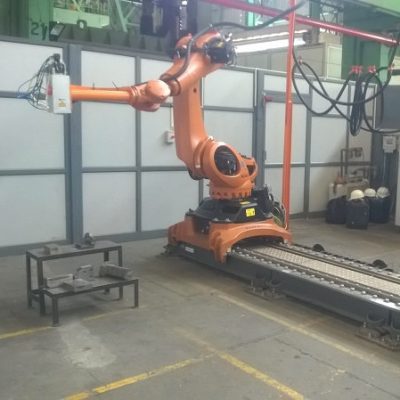
Robotic laser hardening cells
CNC automation platforms industrial laser automation systems
Inline quality monitoring
This ensures repeatability and process consistency for high-volume industrial production.
Key Advantages of Laser Hardening of Wear Plates:
High Precision
Laser systems offer exceptional control over beam size, path, depth, and energy input.
This allows selective hardening of only the wear-prone zones without affecting the entire component.
Low Thermal Distortion
Since heat is concentrated in a localized area, distortion and warpage are significantly lower compared to conventional hardening techniques.
This is especially beneficial for precision-machined wear plates.
Better Wear Resistance
The hardened surface layer offers superior resistance to abrasion, sliding wear, and impact erosion.
This directly translates into longer component life.
Improved Fatigue Life
Laser hardening improves resistance to cyclic stress and repeated loading conditions, helping components withstand prolonged operational use.
Automation Compatibility
Modern laser hardening machine can be seamlessly integrated with robotic arms and automated production lines.
This makes the process ideal for OEM-scale manufacturing and repeat industrial applications.
Lower Downtime
Longer-lasting wear plates mean fewer shutdowns for replacement and maintenance, reducing operational losses.
Industrial Applications
Laser hardening of wear plates is widely used across sectors where component reliability is critical.
Automotive Industry
Used for tooling plates, guide surfaces, stamping components, and wear-critical mechanical parts.
OEM Manufacturing
Ideal for repeatable production of high-performance industrial components with consistent hardness profiles.
Heavy Engineering
Applied in mining equipment, construction machinery, hydraulic systems, and industrial presses.
Turbine Repair
Wear plates and contact surfaces in turbine systems benefit from improved erosion resistance.
Shaft Restoration
Laser hardening is extensively used for shaft journals, bearing seats, and wear sleeves.
Precision Manufacturing
Suitable for high-accuracy parts where dimensional stability is essential.
Why Industries Are Moving Toward Robotic Laser Hardening?
With increasing demand for repeatability and production efficiency, industries are adopting robotic laser hardening solutions.
These systems offer:
Programmable path control
Uniform hardness distribution
Faster cycle times
Reduced manual intervention
Better process traceability
For large wear plates or complex geometries, robotic automation ensures consistent treatment across every production batch.
This makes industrial laser automation a strategic investment for future-ready manufacturing facilities.
Conclusion:
Laser hardening of wear plates is more than just a surface treatment process — it is a strategic manufacturing solution that directly improves component performance, operational reliability, and production efficiency.
By delivering high precision, low thermal distortion, superior wear resistance, and automation compatibility, laser-based hardening has become a preferred technology across automotive, OEM, heavy engineering, turbine repair, and precision manufacturing sectors.
For industries focused on reducing downtime and maximizing equipment life, laser hardening offers measurable long-term value.
Request a Process Assessment
Submit your component details — drawing, photograph, material specification — and our engineering team will assess process suitability and respond with a clear, no-obligation recommendation.