
Archive for Laser Automation
to your success read our blog
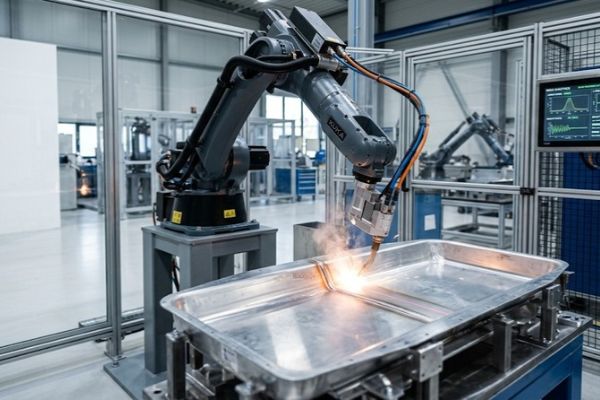
Robotic Laser Welding: From Just a Laser Source to a Data-Driven Welding Cell
Many manufacturers start their robotic laser welding journey by buying a laser source and a robot. That is a good start, but it is no longer the full picture. The real value now comes from a welding cell that can see the joint, adapt to variation, monitor the process, and keep a record of every […]
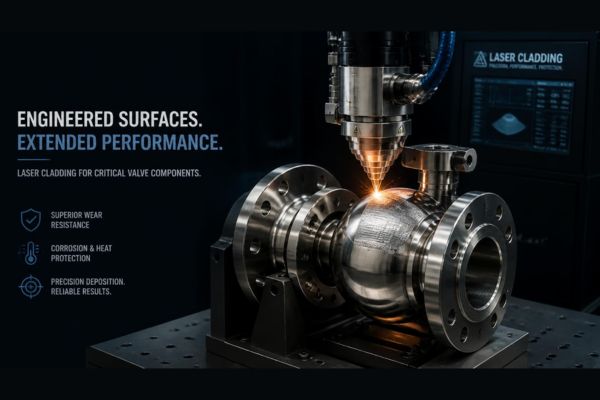
Laser Cladding for Ball Valve
Laser Cladding for Ball Valve is an advanced surface-engineering and additive manufacturing technique used to deposit high-performance alloy powders or metal-matrix composites onto the spherical surface of a valve ball. Because ball valves in industries like oil & gas, mining, chemical processing and power generation face extreme wear, severe erosion, and aggressive corrosion, laser cladding […]
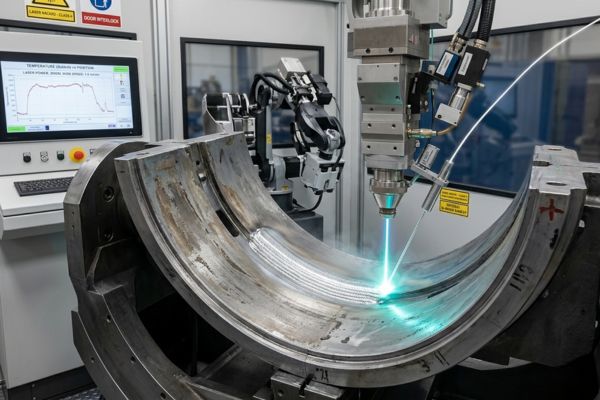
Laser Cladding of Babbitt Bearing
Laser Cladding of Babbitt The failure nobody sees coming Ask any rotating equipment engineer about their worst week on the job and you will usually hear the same story — a turbine, a boiler feed pump or a large gas compressor tripped, the machine came down, and when the bearing was split open the white […]

Hydrogen Fuel Cell Bipolar Plate Laser Welding
Achieving hermetic seals on sub-millimetre stainless steel without porosity requires beam shaping that conventional welding cannot match—this is where real-time melt pool monitoring transforms fuel cell manufacturing from quality control to quality assurance.
India’s hydrogen fuel cell ambitions hinge on mastering the unglamorous but mission-critical challenge: welding micro-thin bipolar plates without introducing the hydrogen leak paths that invalidate entire stacks.
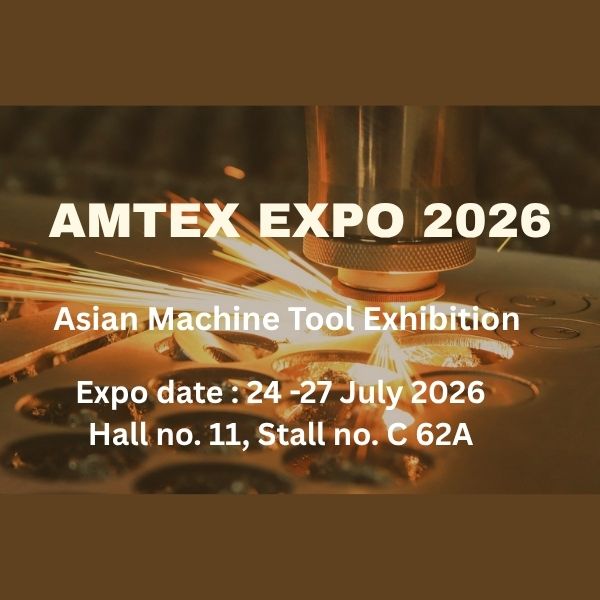
AMTEX EXPO 2026
The AMTEX (Asian Machine Tool Exhibition) is North India’s premier B2B trade fair dedicated to the metal cutting and machine tools industry. It showcases cutting-edge manufacturing technology, industrial automation, and robotics.

Laser Hardening Crankshaft & Camshaft: Precision Hardening for Engine OEMs
Camshaft surface hardening faces identical challenges—conventional methods struggle with variable lobe profiles and non-uniform contact surfaces. Laser hardening delivers consistent hardness on lobes while preserving the core toughness essential for shock loads during engine operation.

Laser Welding – An Efficient Solution to India’s EV Battery Tray Defect Crisis
Laser welding addresses the aluminum welding problem at its root. Rather than flooding a wide area with heat as arc processes do, a laser concentrates immense energy into a precisely controlled beam — melting only the exact material volume required, with minimal heat-affected zone spread.

What is Laser ID Cladding?
Laser Internal Diameter (ID) Cladding is a high-precision additive manufacturing process used to apply a protective coating to the inner walls of tubes, pipes, and bores. It uses a high-powered laser beam to melt a metallic powder or wire onto the internal surface, creating a metallurgical bond that is exceptionally strong.

Laser Hardening of Wear Plates
Laser hardening of wear plates has emerged as one of the most advanced and precise surface treatment technologies in today’s manufacturing ecosystem. By improving surface hardness without compromising the core toughness of the material, laser hardening significantly extends service life, reduces downtime, and enhances performance consistency across demanding applications.

Laser Hardening Services for Automotive Dies, Stamping Tools & CNC Components — Built for High-Volume Manufacturing
Trusted by tooling engineers and plant managers across automotive, heavy engineering, and precision manufacturing. If your tools are wearing down faster than they should, it is time to have a proper conversation about surface treatment.