Ask any rotating equipment engineer about their worst week on the job and you will usually hear the same story — a turbine, a boiler feed pump or a large gas compressor tripped, the machine came down, and when the bearing was split open the white metal lining had lifted clean off the steel shell.
Here is the uncomfortable part: in the large majority of white metal bearing failures, the Babbitt itself was perfectly healthy. It was the bond between the Babbitt and the backing shell that gave up. A void the size of a fingernail, invisible from outside, is enough to interrupt heat flow, create a local hot spot, soften the lining, and start wiping. By the time vibration shows up on the DCS, the damage is done.
For a 25 MW steam turbine or a critical process compressor, that single bond defect can translate into several days of lost production. Which is exactly why the way we apply Babbitt deserves far more attention than it usually gets.
What Babbitt is, and why industry still loves it
Babbitt — also called white metal — is a soft bearing alloy, most commonly tin-based (roughly 88–90% tin with antimony and copper, per ASTM B23 Grade 2/3 or ISO 4381 SnSb8Cu4). Lead-based grades exist, but tin Babbitt dominates critical machinery.
It has survived more than 180 years in service because no modern material has matched its particular combination of behaviours:
Conformability — it deforms slightly to accommodate shaft misalignment and geometric error instead of fighting it.
Embeddability — hard dirt particles get absorbed into the soft matrix rather than scoring the journal. The bearing sacrifices itself to save an expensive shaft.
Excellent anti-seizure behaviour — during boundary lubrication at start-up and coast-down, Babbitt will smear before it welds to the shaft. Low friction and good thermal conductivity, which helps carry heat out of the oil film.
Repairability — a worn bearing shell can be re-lined many times over.
The catch is metallurgical. Tin melts at 232 °C, and the Babbitt alloy is fully liquid by roughly 240–380 °C depending on grade — while the steel or bronze shell it must bond to melts above 1100 °C. That enormous gap is what makes Babbitt lining a genuinely difficult process.
Conventional methods struggle with it. Static and centrifugal casting require the whole shell to be fluxed, tinned and heated to 250–300 °C, which introduces distortion, flux entrapment and oxide inclusions. Slow cooling from the melt lets the hard SnSb cuboids and Cu₆Sn₅ needles grow coarse and segregate, so the microstructure is inconsistent from top to bottom of the layer. Thermal spraying is faster but produces a mechanical, not metallurgical, bond — and any porosity in a sprayed layer becomes a fatigue initiation site. In all these routes, 4 to 10 mm of Babbitt is deposited so that most of it can be machined away, which is wasteful when tin is priced the way it is.
Why laser cladding is the right tool for this particular job?
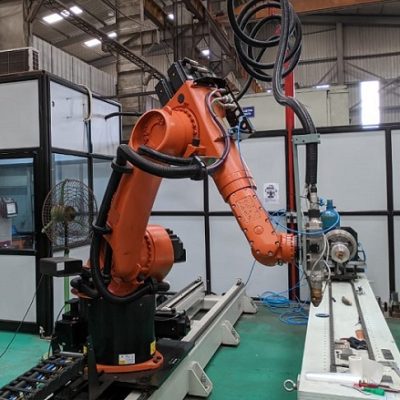
Laser cladding solves the Babbitt problem from the correct end: it controls exactly how much energy goes into the part, and where.
1. Metallurgical bonding with minimal dilution. The laser melts the Babbitt powder or wire and only micro-melts the substrate surface — enough to wet it and form a true metallurgical bond, but not enough to flood the layer with iron. This matters enormously here, because iron and tin form brittle FeSn₂ intermetallics. Keeping that interface layer down to a few microns is the difference between a bond that survives fatigue cycling and one that spalls. Cast and sprayed linings simply cannot dial dilution in the way a laser can.
2. Rapid solidification, finer microstructure. Cooling rates in laser cladding are orders of magnitude higher than in casting. The SnSb hard phase precipitates as fine, evenly dispersed cuboids instead of coarse segregated blocks. The practical result is a lining with better fatigue strength and better load-carrying capacity, without giving up the softness and embeddability that make Babbitt valuable in the first place.
3. Thin, uniform layers — which is what modern bearings actually want. It has been well established in bearing design that thinner Babbitt layers carry higher specific loads. Laser cladding deposits controlled layers typically in the 0.5–2 mm range with consistent thickness, so you machine off a fraction of what casting demands. Less tin bought, less tin scrapped, shorter machining cycle.
4. Almost no distortion. Because the heat input is localised and the part is never bulk-heated, precision thrust pads, split shells and large bearing housings hold their geometry. No re-machining of dovetails or oil grooves because the shell moved.
5. Clean and repeatable. Inert gas shielding replaces aggressive fluxes. Powder feed rate, laser power, speed and overlap are recipe parameters stored in the controller — the tenth bearing comes out like the first, regardless of who is running the machine. For anyone qualifying linings to ISO 4386-1 ultrasonic bond testing or ISO 4386-2 shear strength, that repeatability is what makes acceptance rates predictable.
For Babbitt specifically, a diode laser with a wide rectangular spot is usually the better choice over a small-spot fibre beam. The lower, more uniform power density spreads energy gently across the melt pool, which is exactly what a low-melting-point alloy on a high-melting-point substrate needs.
Where this shows up on the shop floor?
Power generation: turbine journal and thrust bearings. Steam and gas turbine tilting pad thrust bearings live under high specific load with tight thickness tolerances across the pad face. Laser clad linings give a defect-free bond line that clears ultrasonic inspection, and the pads come out of the process flat enough that the finishing operation is genuinely a finishing operation.
Pumps: boiler feed and large process pumps. Multistage BFP bearings see frequent start-stops, and every start is a boundary-lubrication event that loads the bond line. A metallurgically bonded lining survives thermal cycling far better than a sprayed one, which is why plants running critical pump sets increasingly specify laser clad re-babbitting.
Oil, gas and petrochemical: centrifugal compressor bearings. Here the driver is contamination and integrity. API-driven inspection regimes leave little tolerance for porosity or bond voids. Laser cladding under argon shielding produces dense layers with very low inclusion content, and the localised heat means the bearing housing bore stays dimensionally true.
Marine and heavy engineering: stern tube, crosshead and mill bearings. Large slow-speed diesel bearings and rolling mill / crusher bearings are expensive assets that get refurbished rather than replaced. Laser cladding allows selective repair — rebuild only the wiped or worn zone instead of stripping and re-lining the entire shell — which shortens turnaround dramatically during a planned shutdown.
Bearing manufacturers and refurbishment workshops. For anyone doing this as a business, the economics are straightforward: less tin consumed per bearing, less machining time, fewer rejects at the ultrasonic stage, and a documented, parameter-controlled process that a customer’s QA department can audit.
The bottom line:
Babbitt is not going anywhere. Hydrodynamic bearings remain the only sensible answer for high-speed, high-load rotating machinery, and white metal remains the best lining material for them. What has changed is that the century-old ways of putting Babbitt onto a shell are no longer good enough for the loads, speeds and uptime expectations of modern plants.
Laser cladding closes that gap. It replaces a metallurgically uncontrolled process with a metallurgically precise one — a genuine bond, a fine microstructure, a thin uniform layer, and a part that comes out the same shape it went in.
At Laser Automation Pvt. Ltd., we have spent over 16 years building laser cladding, welding and hardening special purpose machines for Indian industry. If you are lining or refurbishing white metal bearings, the sensible next step is a trial on your own component in our in-house application lab — real substrate, real Babbitt grade, real cross-section and bond evaluation — before anything is designed or quoted.
Talk to us about a Babbitt laser cladding SPM built around your bearing sizes. Contact Now