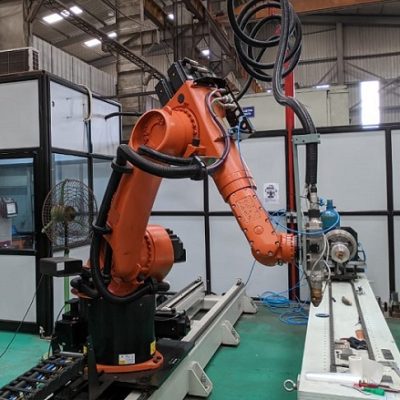
Laser Internal Diameter (ID) Cladding is a high-precision additive manufacturing process used to apply a protective coating to the inner walls of tubes, pipes, and bores. It uses a high-powered laser beam to melt a metallic powder or wire onto the internal surface, creating a metallurgical bond that is exceptionally strong.
Unlike traditional arc welding methods, laser cladding provides a much more “surgical” application of material, which is critical when working within the tight confines of a cylinder.
The Mechanism
The process requires a specialized optical lance—a long, slender arm equipped with internal mirrors or fiber optics. This lance directs the laser beam and the coating material (usually powder) through a nozzle at a 90-degree angle (or a specific tilted angle) to hit the inner wall.
Why Choose Laser for ID Cladding?
Laser technology offers several distinct advantages over traditional welding overlays:
Low Heat Input: The laser focuses energy so tightly that it minimizes the “Heat Affected Zone” (HAZ). This prevents the base part from warping or losing its mechanical properties.
Minimal Dilution: In traditional welding, the base metal and the coating often mix too much, weakening the coating. Laser cladding keeps dilution extremely low (often below 5%), ensuring the protective layer remains pure.
Precision and Thinness: It can apply very thin layers (from 0.5mm to 2mm) with high accuracy, reducing the amount of expensive material used and the amount of post-process machining required.
Small Bore Capability: Advanced lances can now reach into bores as small as 50mm in diameter, which is difficult or impossible for manual or traditional automated welding heads.
Technical Comparison
Feature
Traditional Arc Cladding
Laser ID Cladding
Bond Type
Metallurgical
Metallurgical
Dilution
High
Very Low (Below 5%)
Precision
Low (requires heavy machining)
High (near-net shape)
Thermal Distortion
Significant
Minimal
Best For
Large, thick-walled pipes
Precision components/Valves
Common Material Combinations
The choice of “cladding” material depends on the environment inside the pipe:
Cobalt-based alloys (e.g., Stellite): For extreme wear and high-temperature resistance.
Nickel-based alloys (e.g., Inconel 625): For superior protection against corrosion in “sour” or acidic environments.
Tungsten Carbides: Used when the internal surface faces extreme abrasion from sand, rocks, or slurries.
Industry Examples
This process is the “gold standard” for components that are expensive to replace and operate in harsh conditions, such as hydraulic cylinders, mud motors used in drilling, valve bodies for chemical plants, and bearing seats in heavy machinery, Components used in Oil and Gas industries, etc.