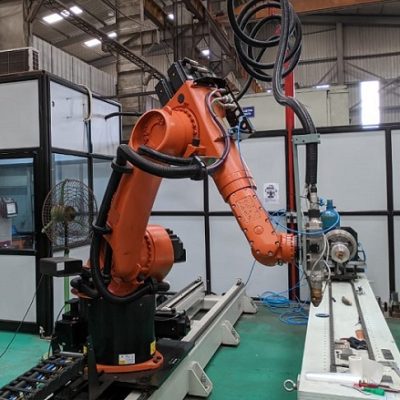
Once a niche process in specialized aerospace applications , laser cladding has now found applications in the agricultural field as well. By precision Engineering of harvesting and other ground engaging tools, this technology addresses the abrasive wear of tools caused during harvesting of crops and due to soil, stones etc.
BENEFITS OF LASER CLADDING IN MODERN AGRICULTURE:
The limitation in traditional hardening method was that structural integrity of the tool often needed to be compromised to some extent. Even though the abrasion resistance was achieved it often came at a cost of making the tool brittle. However, by enhancing the abrasive resistance of the tool while still maintaining the core impact resistance, Laser Cladding achieves best of both worlds.
Minimal Thermal distortion – Laser beam is highly focused, so the Heat Affected Zone is minimal which reduces the risk of warping and thermal distortion.
Metallurgical Bond – Unlike other material deposition methods where the bond between the base material and cladded material is mechanical , bonds formed by Laser Cladding are metallurgical. So, it does not chip off or flake and can withstand high impact encounters with rocks and other harsh conditions required for agricultural operations.
MATERIAL SCIENCE : MATCHING POWDER TO PURPOSE
Which alloy powder should be used for which type of tool ?? It depends on which environment the tool is to be used in and what is the purpose
Tungsten Carbide – This is excellent for higher wear resistance. Generally this is used for plowshares and tillers operating in stony or sandy environments.
Iron Based Alloys – If a cost effective solution is required for enhancing general wear resistance of some primary tillage tools, this is a good option.
Stellites – In certain cases, there is risk of corrosion from fertilizers/pesticides and the tools have to face wear as well. For such applications, stellites are used for their corrosion ad wear resistance.
PRACTICAL APPLICATIONS
1. Harvesting: Knife sections, base cutters (for sugarcane), and feed rolls. 2. Tillage: Plow points, cultivator sweeps, and sub soiler teeth. 3. Animal Feed: Mixer wagon blades and hammer mill tips. 4. Seeding: Disc openers and scrapers.
In an era where efficiency is everything, laser cladding isn’t just an upgrade—it’s a commitment to longer tool life, reduced downtime, and a more sustainable approach to modern farming.